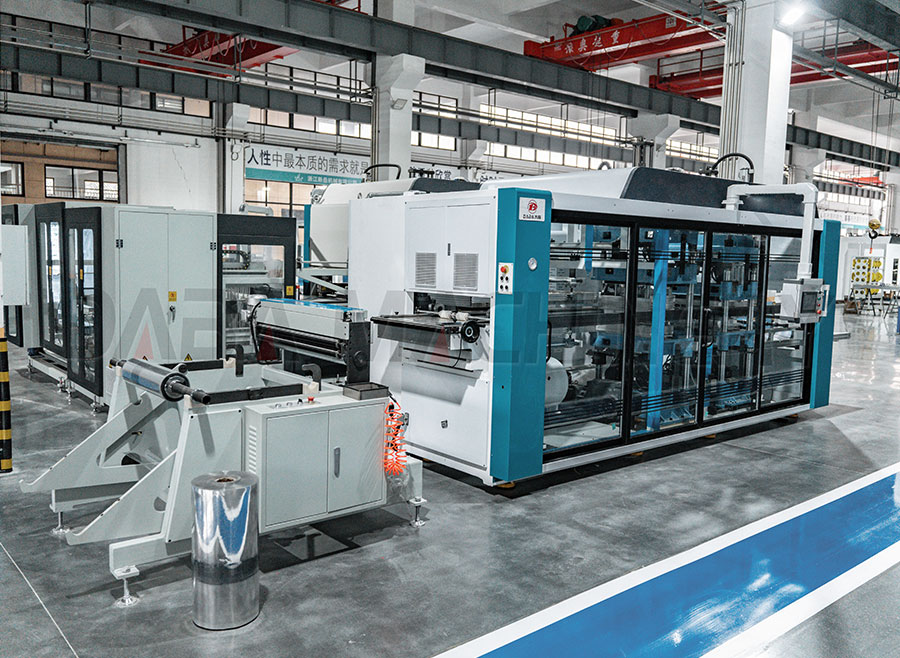
How to Choose Thermoforming Machines by Capacity Complete Selection Guide from Small to Mass Production
May 25, 2026
Most plastic and packaging factory owners make costly mistakes when purchasing thermoforming equipment, not from overpricing, but from mismatched machine capacity and production demands. Blindly investing in high-speed machines leads to idle equipment, high energy consumption and capital waste. On the contrary, choosing low-end machines for large orders results in insufficient output, delayed deliveries and lost market opportunities.
As the core equipment for producing plastic packaging, food containers and agricultural trays, thermoforming machines directly determine production line efficiency and profit margins. With years of experience in plastic container machinery manufacturing, Daba Machinery offers a full product lineup including cup machines, thermoforming machines, sheet extrusion machines, lid machines, cutting equipment, auxiliary machines and customized molds. This professional selection guide covers full-capacity scenarios for small workshops, large-scale factories and foreign trade OEM manufacturers.
1. What Factors Determine the Actual Capacity of a Thermoforming Machine?
Many buyers only refer to theoretical capacity data provided by suppliers and ignore real production efficiency, resulting in low actual output. Four core factors determine the true capacity of a thermoforming machine:
- Molding Cycle Speed: The core industry standard. High-speed machines complete one mold cycle in 2-3 seconds, while standard machines take 8-15 seconds. Shorter cycles mean higher hourly output and stronger production capacity.
- Effective Molding Area: A larger molding table allows more mold cavities per cycle, greatly increasing single-time output and improving mass production efficiency.
- Automation Level: Fully automatic machines with auto feeding, auto stacking, online cutting and auto collecting support 24-hour unattended operation. Semi-automatic machines require manual assistance and deliver lower actual capacity.
- Material Compatibility: Machines equipped with professional heating, vacuum and cooling systems adapt to PET, PP, PS and PLA materials. Stable molding performance directly improves yield rate and effective production capacity.
In short: Theoretical capacity depends on parameters; actual capacity depends on cycle speed, automation level and material adaptability.
2. Thermoforming Machine Selection by Capacity: From Small Batch to Mass Production
Based on Daba Machinery’s equipment portfolio and mainstream market demands, we classify thermoforming machines into four capacity levels to match different order volumes, product types and factory scales.
2.1 Small Capacity Machines: Ideal for Sampling & Multi-Variety Small Batch Orders
Daily Output Capacity: 10,000 – 50,000 pcs/day
Application Scenarios: New product sampling, customized small-batch orders, startup factories, small-scale processing and flexible trade OEM production
Suitable Products: Small sauce cups, plastic lids, blister trays, small-batch PLA biodegradable food containers and test seedling trays
Machine Advantages: Compact size, low investment cost, easy mold replacement, simple operation and low energy consumption. Equipped with Daba’s professional small molds and auxiliary machines, the equipment requires minimal labor and site space, perfectly fitting flexible customized orders.
Unsuitable Scenarios: Large-scale standardized mass production, super-large foreign trade orders and long-term high-load continuous production.
2.2 Medium Capacity Machines: Cost-Effective Choice for Medium & Small Factories
Daily Output Capacity: 50,000 – 150,000 pcs/day
Application Scenarios: Medium and small packaging factories, stable domestic and medium-sized foreign trade orders, balancing production efficiency and flexibility
Suitable Products: Disposable food containers, transparent PET fruit and vegetable packaging boxes, plastic egg trays, agricultural seedling trays and PP food storage boxes
Machine Advantages: Adopts high-precision servo drive system with positioning accuracy of ±0.1mm for stable molding and high yield rate. It can form a complete production line with Daba sheet extrusion machines, cutting equipment and lid machines, realizing one-stop production from sheet extrusion, molding and cutting to final collection. It supports flexible product switching and delivers outstanding cost performance.
Core Value: Avoid insufficient capacity of small machines and excessive cost of high-end machines, serving as the best choice for factory expansion and stable order delivery.
2.3 High Capacity Machines: Mainstream Equipment for Large-Scale Mass Production
Daily Output Capacity: 150,000 – 300,000 pcs/day
Application Scenarios: Large packaging enterprises, long-term stable bulk orders, fixed food packaging supporting production and high-load continuous manufacturing
Suitable Products: Mass-produced PLA eco-friendly biodegradable lunch boxes, standard plastic egg trays, agricultural seedling trays and supermarket-grade fruit and vegetable fresh-keeping boxes
Machine Advantages: Integrated multi-station design completes molding, cutting and stacking simultaneously to shorten production cycles. Equipped with intelligent temperature control and infrared heating systems, it saves over 30% energy compared with traditional machines and supports 24-hour stable operation. Matched with Daba precision customized molds, it ensures high product consistency, low material loss and reduced overall production costs.
2.4 Ultra-High Speed Machines: Professional for Large Factory & Export Bulk Orders
Daily Output Capacity: Over 300,000 pcs/day
Application Scenarios: Standardized large factories, cross-border bulk orders, brand food packaging supporting and large-scale biodegradable packaging production
Suitable Products: Standardized food containers, bulk export egg trays, large-batch agricultural seedling trays and eco-friendly PLA disposable packaging products
Machine Advantages: High-speed servo multi-station structure shortens molding cycles to 2-3 seconds. Fully automatic systems including auto feeding, auto cutting, unmanned stacking and intelligent error correction realize unattended mass production. Featuring low failure rate and high uptime, it minimizes unit production cost and supports super-large order manufacturing for leading packaging enterprises.
3. Key Selection Tips for Different Materials & Products
Even thermoforming machines with the same capacity deliver different efficiency for different materials and products. Capacity selection must match specific production needs:
- PET Transparent Fruit & Vegetable Packaging: PET material is hard and requires high molding precision. Medium and high-capacity precision machines are recommended to ensure scratch-free, full-molding transparent packaging for high-end supermarket applications.
- PLA Biodegradable Eco-Packaging: PLA bio-based materials are temperature-sensitive. Machines with precise temperature control systems are required to avoid deformation and defective molding, balancing material characteristics and mass production stability.
- Plastic Egg Trays & Seedling Trays: These products feature regular structures and multiple cavities. Machines with large molding areas and high-speed cycles maximize single-cycle output to meet large-volume agricultural supply demands.
- Conventional PP/PS Food Containers: Mature molding technology allows flexible selection of medium or high-capacity machines for fast production and quick return on investment.
4. Common Capacity Selection Mistakes 90% of Buyers Make
Avoid these mistakes to select the most cost-effective and suitable thermoforming equipment:
- Only focusing on theoretical capacity while ignoring actual automation performance and material compatibility, leading to lower real output than advertised data.
- Investing in high-speed machines for small-batch orders, causing equipment idleness, high energy consumption and prolonged payback period.
- Using low-capacity machines for large orders, resulting in insufficient peak-season capacity and lost customers.
- Purchasing standalone machines without supporting sheet extrusion, cutting, molds and auxiliary equipment, causing unsmooth production line connection and restricted overall capacity.
5. Daba Machinery: One-Stop Full-Capacity Thermoforming Solutions
As a professional manufacturer of full-set plastic food container machinery, Daba Machinery provides complete equipment series: Cup Machines, Thermoforming Machines, Sheet Extrusion Machines, Lid Machines, Cutting Equipment, Auxiliary Machines and Custom Molds.
We customize exclusive production solutions according to customers’ order capacity, product types, raw material requirements and budget, including economical standalone solutions, semi-automatic production lines and fully automatic unmanned production lines. Our equipment supports PET, PP, PS and PLA material processing, covering small-batch sampling to ultra-large-scale mass production, helping customers control costs and boost profits efficiently.
Conclusion
The core of thermoforming machine selection is not choosing the most expensive or fastest equipment, but matching the machine capacity with your actual orders, product types and long-term development plans. Choose flexibility for small batches, cost performance for medium batches, stability for large batches, and ultra-high efficiency for super mass production.
If you are confused about machine selection, feel free to contact Daba Machinery. We provide free professional equipment selection and production line configuration solutions based on your product specifications, daily output demands and material requirements.
FAQ
Q1: Is it necessary for small factories to buy high-speed thermoforming machines?
A: It is not recommended. Small factories usually have scattered orders and diverse product types. High-speed machines feature high investment and low flexibility. Medium and small-capacity machines offer higher cost performance and fully meet daily production demands.
Q2: Do I need a special thermoforming machine for PLA biodegradable packaging?
A: Yes. Machines equipped with precise temperature control systems are highly recommended to adapt to the characteristics of PLA bio-based materials, improve product yield and ensure stable mass production.
Q3: Can thermoforming machine capacity be upgraded later?
A: Yes. Daba thermoforming machines support modular upgrades. You can improve production capacity and efficiency by adding automatic auxiliary devices, replacing precision molds and optimizing system parameters to meet future factory expansion needs.
Q4: Can one thermoforming machine produce both egg trays and seedling trays?
A: Yes. A single thermoforming machine can quickly switch between producing plastic egg trays, agricultural seedling trays and other shaped products by replacing customized molds, with strong versatility and low procurement cost.
Q5: What machines are included in a complete thermoforming production line?
A: A full production line consists of sheet extrusion machine, thermoforming host, cutting equipment, lid making machine, auxiliary machines and customized molds. Daba Machinery provides one-stop full-line supporting services.
Q6: Do different raw materials affect thermoforming machine production capacity?
A: Yes. Special materials such as PLA and PET have stricter requirements on heating temperature and molding speed, resulting in slightly lower capacity than conventional PP and PS materials. Professional parameter debugging and customized molds can balance production efficiency and product yield.
Q7: How to choose between fully automatic and semi-automatic thermoforming machines?
A: Choose semi-automatic machines for small-batch, multi-variety production with limited budgets. Choose fully automatic machines for stable large orders to realize 24-hour unattended production, save labor costs and maximize output.